
 Español
  Português PT
CPU Prices Are Rising in 2026: Intel Confirms It Quietly
- 06 Jul, 2026
- Home , News
- 0 Comments
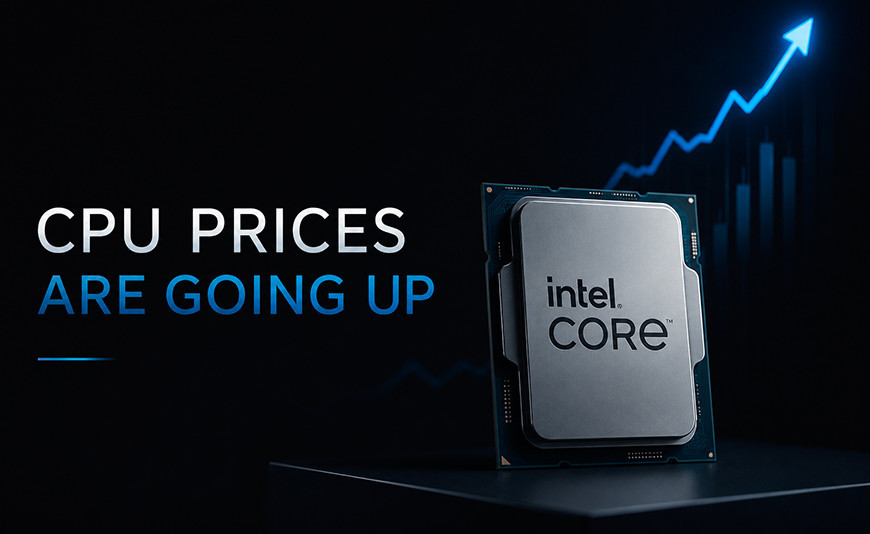
Intel just raised processor prices — without saying a word:
first it was RAM, now it's CPUs (and here's what you can still lock in today)
With no press release or official statement, Intel has quietly updated the recommended prices of its Core Ultra 7 270K Plus and Core Ultra 5 250K Plus — processors launched just months ago as its most aggressive answer to AMD. The move confirms what supply chain reports have been warning for months: CPUs could get up to 30% more expensive over the course of 2026. If RAM prices were already a concern, this adds a second hit to your next PC budget. But there's one part of your build that remains completely unaffected by this wave.
The 2026 CPU price hike at a glance
A silent hike, no announcement. Intel updated the official prices of its Core Ultra 7 270K Plus and Core Ultra 5 250K Plus directly on its product specification pages, with no public statement of any kind.
This is not a one-off. Since March, consumer CPUs from Intel and AMD have accumulated increases of between 5% and 20%, with additional rounds already expected in Q3 and an estimated ceiling of up to 30% for 2026 as a whole.
Same root cause as RAM: AI. Data centres are competing for the same advanced manufacturing capacity (3nm, 2nm) as consumer CPUs, leaving less and less room for the retail market.
The smart move: with RAM and CPUs both rising, locking in your power supply, CPU cooler and chassis today — components that don't rely on these chips — is the only part of your PC build with zero downside risk right now.
A few months ago we were talking about the RAM shortage as an isolated problem. It no longer is. What started in memory has spread to processors, and all signs point to it continuing to spread to other components for the rest of the year. The question is no longer "will RAM go up?" — it's "which part of my PC is next?".
The good news is that not every part of a PC is exposed to this wave. Power supplies, CPU coolers and cases rely on completely different materials and manufacturing processes than a memory chip or a cutting-edge processor, and their prices have been essentially frozen for a year. Buying those parts of your build well right now is the decision you'll be least likely to regret in 2026.
1. What exactly happened with Intel CPU prices
Intel has raised the recommended retail price of two of its most recent processors — the Core Ultra 7 270K Plus and Core Ultra 5 250K Plus from the Arrow Lake Refresh family. There was no official announcement: the change appeared directly on the company's product specification pages, which is exactly what tends to happen when a brand would rather not draw attention to bad news. These two models launched just months ago as Intel's most competitive answer to AMD's mid-range Ryzen lineup, at price points of $199 and $299 that made them genuinely attractive.
In plain terms: it's like a supermarket quietly changing the price tag on two products with no sign, no notice, hoping almost nobody notices. The difference here is that we're talking about the CPU that will be the brain of your next PC — and this hike is not an isolated event. It's the continuation of a trend that's been building across the entire industry for months.
| Event | Approximate date | Increase |
|---|---|---|
| Intel's first consumer CPU price adjustment | March 2026 | ~5–10% |
| Server chip adjustment (Intel and AMD) | April 2026 | ~10–20% |
| Silent hike: Core Ultra 7/5 Plus | July 2026 | No official figure confirmed |
| 80+ Bronze power supply | All of 2026 | ~0% |
| CPU cooler / PC case | All of 2026 | ~0% |
2. Why CPUs are going up too (and it's no coincidence it's happening alongside RAM)
The underlying cause is the same as the memory crisis: artificial intelligence. The most modern processors are manufactured on advanced nodes — 3nm and 2nm — the same production capacity being fought over by AI accelerators, data centre GPUs and the custom chips of the world's biggest tech companies. When multiple industries compete for the same fabs, the one that pays the most wins, and that's rarely the consumer market.
In plain terms: imagine a precision tailor's workshop with a single high-end sewing machine. If a client who pays far more books it all day for a massive order, the rest of the jobs — yours — have to wait or pay more to jump the queue. That's exactly what's happening with chip fabs: AI has become the client who pays the most, and your next CPU either waits its turn or pays the premium.
The first serious warning came from Korean outlet ETNews, which revealed that Intel had already notified its major customers of a ~10% increase on consumer processors from late March. Shortly after, Taiwanese portal CTEE confirmed that TSMC is still expanding its 3nm capacity despite being close to handing over to N2 — an unusual move that only makes sense given the simultaneous pressure from CPUs, GPUs and AI accelerators competing for the same fab capacity. On top of that, Intel invested $14.2 billion to buy back 49% of its Fab 34 plant in Ireland, a key facility for its Intel 4 and Intel 3 processes, in an attempt to regain control of its own supply ahead of future AI-driven demand.
What to buy now vs. what to wait on in 2026
Buy now: power supply
It doesn't depend on CPU or memory manufacturing nodes. Its price hasn't moved and has no reason to move because of this hike.
Buy now: CPU cooler and case
These are mechanical parts — no silicon involved. A good cooler and a good case will serve you across multiple CPU generations, whatever prices do.
Monitor before buying: CPU and RAM
Here it pays to compare prices across generations and keep an eye on the next expected round of hikes in Q3 before committing your budget.
3. The power supply: the component that protects your investment in an expensive CPU
If you're going to pay more for your next CPU, the last thing you need is a low-end power supply putting that investment at risk. An underpowered or poor-quality PSU doesn't just underperform — in a scenario where every component costs more than it did a year ago, it's the part most likely to cause cascading damage to your CPU, motherboard or GPU if it fails.
| Your situation | Recommendation | Why |
|---|---|---|
| Building a new PC this year | Buy PSU, cooler and case now | Lock in stable prices while you wait for the right moment to buy the CPU |
| Your current PSU is 4–5 years old | Replace it now | Protect a CPU that costs more today than it did a few months ago |
| Planning to upgrade the CPU later | Buy a PSU with headroom now | Avoids a second PSU purchase in the middle of peak price hikes |
| Tight budget this quarter | Prioritise PSU and cooler over rushing the CPU | These are the only items on your list that won't get more expensive |
Hiditec BZ PRO — lock it in today at today's price
The Hiditec BZ PRO line offers 80 PLUS Bronze certification, Japanese capacitors and enough wattage to support your next CPU — Intel or AMD — without having to revisit this component when the price hike is at its worst. It's exactly the kind of purchase that makes sense to close out now, while the price is still what it always was.
4. Cooling and case: the other part of your PC that isn't going up in price
If you're planning to stretch the life of your current CPU while waiting for prices to settle, the smartest move is to make sure the rest of the system runs in optimal condition for as long as possible. That means low temperatures and proper airflow — two factors that depend directly on the cooler and case you choose.
DC20 PRO, DC40 PRO and H3 PRO: the foundation that frees up budget for when it's time to upgrade
Hiditec DC20 PRO
Single-tower cooler designed for mid-range builds, with enough thermal headroom to extend the life of your current CPU without throttling performance while you wait for prices to come down. [AMAZON LINK DC20 PRO]
Hiditec DC40 PRO
Dual-tower for anyone planning to push their current CPU harder and for longer than originally planned. More thermal margin means the processor stays at its maximum frequency even under sustained load. [AMAZON LINK DC40 PRO]
Hiditec H3 PRO
Optimised-airflow case with cable management, ATX and MicroATX compatible. Buying it now, at a stable price, leaves your next budget free to focus solely on the CPU when the market calms down. View H3 PRO on Amazon
5. Which component will be next to go up?
The logic of this crisis is always the same: first go the components that share manufacturing capacity with AI — memory, high-end GPUs, and now CPUs — while mechanical parts stay out of the blast radius. Multiple supply chain sources are already anticipating another round of processor price increases for Q3 2026, so this is probably not the last chapter of the year.
The practical conclusion is unchanged from what we said about RAM: CPUs may have occasional windows of better pricing between generations, but your power supply, cooler and case will never be cheaper than they are right now. Closing that part of your purchase today is the only decision in this crisis that carries zero downside.
Buy now if...
Your current PSU is more than 4 years old
You're building a new PC in the coming months
You want to lock in stable prices before they move
You don't want to be caught out by another silent hike like this one
Wait and watch if...
You only need to buy a CPU or RAM
You can afford to wait for the next generation
Your current setup doesn't urgently need an upgrade
You're tracking the next Q3 price round closely
Frequently Asked Questions about the 2026 CPU price hike
Everything you need to know before planning your next PC purchase
Which Intel processors have gone up in price?
The confirmed increases so far are for the Core Ultra 7 270K Plus and Core Ultra 5 250K Plus from the Arrow Lake Refresh family, reflected directly on Intel's official specification pages with no prior notice. Supply chain sources suggest that other lines — including older generations like Raptor Lake — could follow the same path.
How much could CPUs go up by in 2026?
Various supply chain sources put the cumulative increase for consumer processors at between 20% and 30% across the year, with additional rounds already expected in Q3. On the server side, AMD is forecasting a combined increase of around 16–17% across two separate hikes.
Why aren't power supplies and coolers affected?
Because they don't depend on the advanced manufacturing nodes (3nm, 2nm) being competed over by CPUs and AI memory. Their materials — capacitors, coils, copper heatpipes, steel chassis — are not subject to the same supply-and-demand pressure, so their prices remain stable.
Is it worth buying a higher-wattage PSU than I need right now?
Yes, especially if you're planning to upgrade your CPU or GPU in the future. A PSU with enough headroom for your next upgrade means you won't have to replace it again when that moment comes — saving you a second purchase right in the middle of peak prices.
Is AMD affected too?
Yes. AMD has also applied price increases in its server lineup, and the pressure from advanced manufacturing nodes is expected to hit its consumer catalogue as well over the course of the year.
Sources:
- Blog elhacker.NET: Intel quietly raised the recommended price of its Core Ultra 7 270K Plus and Core Ultra 5 250K Plus CPUs
- Infobae: Processors will be more expensive in 2026 — Intel and AMD raising CPU prices
- El Chapuzas Informático: Intel and AMD push a new CPU price hike amid the AI boom
- HardZone: Intel and AMD processor prices surge 20%
- Profesional Review: Intel could raise CPU prices by up to 30% in 2026
- HD Tecnología: Intel to raise CPU prices by up to 10% due to AI pressure (original source: ETNews, South Korea)
- MuyComputer: Intel confirms processor prices will rise
- Infobae: First RAM, now CPUs — Intel preparing a new price increase (original source: Minutes Logic Society)
- El Chapuzas Informático: Intel warns of the next CPU price hike driven by AI inference demand
- El Chapuzas Informático: Intel raises recommended price of Core Ultra 7 270K Plus and Core Ultra 5 250K Plus
- Amazon Spain: Hiditec BZ PRO — 80 PLUS Bronze power supply






Leave a Reply Cancel Reply