
 Español
  Português PT
Physical Game Discs Are Disappearing — Even on PC: Why Your Hardware Is Now Your Only Backup | Hiditec Global
- 03 Jul, 2026
- Home , News
- 0 Comments
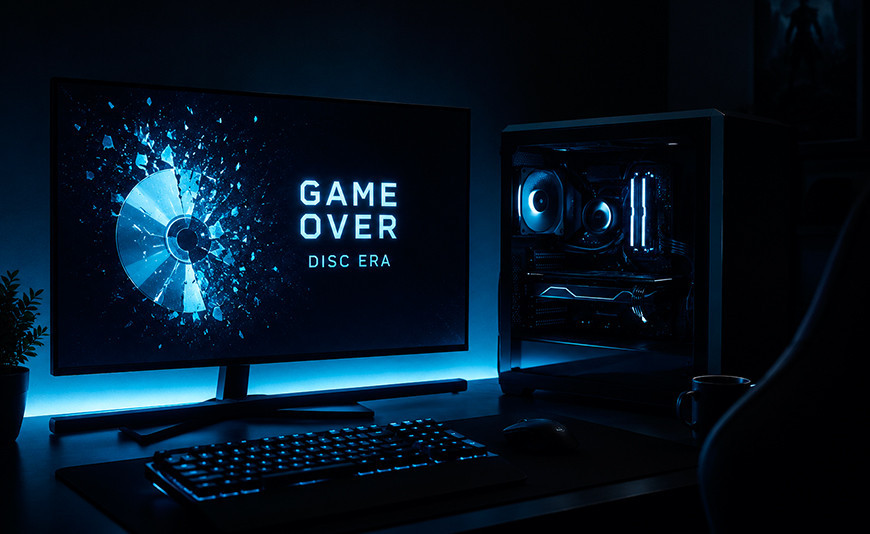
Sony has just confirmed the end of physical PlayStation discs:
PC gaming has been playing this match for years, and we already know how to win it
Sony announced this week that it will stop manufacturing physical discs for new PlayStation releases from January 2028. Days earlier, it was confirmed that the physical edition of GTA VI won't even include a disc: it will be a box with a download code. On PC, this conversation is already old news, but the headline raises an interesting question for any PC gamer: if your entire library lives inside your computer and there's no longer a backup disc, which part of your rig can you really not afford to fail?
The essentials of the physical disc phase-out
Sony has put an expiry date on the disc. From January 2028, new PlayStation games will be sold exclusively in digital format, both through the online store and via physical retailers, who will no longer have a disc to sell.
GTA VI already got there first. The day-one physical edition of the most expensive entertainment production in history won't include a disc at all: it will be a box containing a download code, a preview of where the whole industry is heading.
On PC, this isn't news. The vast majority of PC cases no longer include 5.25" bays for optical drives, and platforms like Steam, Epic or GOG have been the norm, not the exception, for more than a decade.
The real consequence: without a backup disc, your entire library now depends on your power supply, cooling and case never failing. Hardware is no longer just about performance — it's the only backup copy you have left.
For more than three decades, the disc was more than just a storage medium — it was insurance. If your PC failed, you always had that box on the shelf to reinstall the game from scratch. That safety net disappears for PlayStation from 2028 and, in practice, has already been gone for PC for years. The difference is that nobody in PC gaming thinks of it as a loss, because the whole ecosystem was already built around it.
That doesn't mean there's no new risk involved. Without a physical disc, your hardware's reliability goes from being "nice to have" to being the only real guarantee that your game library will still be accessible tomorrow.
1. What Sony has actually announced (and why GTA VI got there first)
Sony Interactive Entertainment confirmed via an official PlayStation Blog post that physical disc production for new releases will end starting January 2028. From that date on, any new game will be sold exclusively in digital format, whether through the PlayStation Store or at physical retailers, who will shift to selling digital licences instead of discs. The company justified the decision by pointing to changing consumer behaviour toward digital downloads.
Just days earlier, Rockstar had confirmed a detail that hinted at this shift: the day-one physical edition of GTA VI, the release with the highest production budget in entertainment history, won't include a disc inside the box — just a download code. The optical drive is no longer guaranteed, even in the "physical" editions of the biggest releases.
In plain terms: imagine a local library that stopped buying paper books and only offered password-protected e-readers instead. The content is still there, but you can no longer lend it to a friend, resell it second-hand, or count on it being available if the library ever closes. That's broadly what has just happened in consoles, and what PC gamers have already accepted as the normal way to play for years.
2. PC gaming already lives in the post-disc era (and its cases prove it)
While the console industry debates this shift as breaking news, on PC the disc is already close to a collector's curiosity. Steam, Epic Games Store and GOG have been the standard way to buy and play games on PC for more than a decade, to the point that most modern cases have simply removed the 5.25" bays once reserved for optical drives. If you wanted to build a PC with a CD/DVD drive today, you'd have to specifically hunt down models that still keep that slot — an increasingly rare feature in current case line-ups.
| Aspect | PlayStation (up to now) | PC (for years already) |
|---|---|---|
| Main purchase format | Physical disc + digital | Digital download (Steam, Epic, GOG) |
| Internal space reserved for optical drive | Built-in optical bay by default | Virtually eliminated in modern cases |
| "Physical" backup copy | Existed until now (the disc) | Doesn't exist: everything lives on internal storage |
| Average size of current games | 100–200+ GB for AAA titles | Equal or larger, with no physical backup |
3. Without a disc, your hardware is the only safety net you have left
When the disc existed, a power outage, a voltage spike or a faulty component was a setback: you'd reinstall and move on. In a fully digital ecosystem like the one PC gaming already lives in — and the one PlayStation is now heading toward — that same incident can mean hours of downloading, save files at risk, or, in the worst case, cascading damage to other components if the power supply fails abruptly. The PSU is no longer just "the part that supplies power": it's the part that protects everything else from failing too.
| Risk in a fully digital era | What prevents it | Why it matters more than ever |
|---|---|---|
| Voltage spike damaging the motherboard, CPU or GPU | PSU with certified OVP/OCP/SCP protections | There's no backup disc: damage to the rig can compromise access to your whole library |
| Overheating from constant background downloads and updates | Cooler with sufficient thermal headroom | A digital-only PC never "rests": it's constantly receiving patches, downloads and syncs |
| Poor airflow from dust buildup and cable clutter | Case with optimised airflow and cable management | Storage drives (SSD/HDD) are especially sensitive to sustained heat over time |
| PSU falling short when adding storage or upgrading the GPU | PSU with extra wattage headroom from the start | Digital libraries keep growing, demanding more storage drives over time |
Hiditec BZ PRO — the foundation that protects your digital library
The Hiditec BZ PRO range offers 80 PLUS Bronze certification, Japanese capacitors and electrical protections designed so that a mains fault doesn't turn into a problem for the rest of your PC. When there's no longer a physical disc to fall back on, a reliable PSU is the difference between a passing scare and losing access to your entire game library.
4. No optical drive means more room for what really matters: airflow and temperature
The disappearance of the optical bay isn't just symbolic — it frees up physical space inside the case that today goes toward better airflow, more fans and tidier cable management. In a PC that's going to be downloading, updating and syncing your library almost constantly, that extra space dedicated to cooling is what stops accumulated heat from shortening the lifespan of your SSD, CPU or GPU.
H3 PRO and DC20 PRO: the space the optical drive used to take up, now working for you
Hiditec H3 PRO
A case with optimised airflow and cable management, ATX and MicroATX compatible, built for a PC that no longer needs room for an optical drive and can dedicate that space instead to moving air and keeping your storage drives cool. [AMAZON LINK H3 PRO]
Hiditec DC20 PRO
A single-tower cooler with enough capacity to keep your CPU stable even during prolonged background downloads, installs and syncs — the new normal for any fully digital library. [AMAZON LINK DC20 PRO]
5. Thinking of switching to PC gaming?
If Sony's announcement has left you feeling like you're paying for a licence rather than actually owning a game, you're not alone: the gaming community has reacted strongly, pointing out that buying digital typically means acquiring a personal-use licence, not ownership of the product. On PC, that conversation has been on the table for years, and platforms like GOG have built part of their identity around DRM-free libraries that don't depend on a store staying open tomorrow.
If you're weighing up a move to PC, the good news is that building a solid foundation doesn't require overspending: it comes down to choosing the right three components to carry your rig for years, without needing to touch them again every time you swap your GPU or CPU.
The foundation for your first gaming PC
PSU: Hiditec BZ PRO, 80 PLUS Bronze with Japanese capacitors
Case: Hiditec H3 PRO, optimised airflow and cable management
Cooling: Hiditec DC20 PRO, thermal stability for continuous use
Why start here
These are the three components you won't need to replace for years, no matter how many times you upgrade your GPU or CPU
They offer the most competitive value for making the switch without overspending
They leave room in your budget for where it counts most: the GPU
Frequently asked questions about the end of physical discs
What you need to know whether you play on PlayStation, Xbox or PC
When does Sony stop making physical discs?
From January 2028, all new PlayStation releases will be sold exclusively in digital format, both through the PlayStation Store and via physical retailers. Games already released or planned before that date are not affected.
Is it true GTA VI's physical edition won't include a disc?
According to leaked details about the launch edition, the day-one physical box will include a download code instead of a disc, although a possible disc-based edition has been mentioned for later in December 2026.
Why isn't this new for PC gaming?
Because platforms like Steam, Epic Games Store or GOG have been the standard way to buy PC games for more than a decade, to the point that most current cases don't even include bays for an optical drive anymore.
If I buy a game digitally, do I actually own it?
Not exactly: on most digital storefronts, including the PlayStation Store, what you're acquiring is a personal-use licence, not ownership of the product. Platforms like GOG are an exception, offering DRM-free games that stay in your library even if the title is later removed from the store.
Which PC components matter more in a fully digital world?
Mainly the power supply, given its role protecting the rest of the system from electrical faults, along with cooling and the case, which are responsible for stopping heat from constant downloads and updates from shortening your storage drive's lifespan.
Sources:
- Engadget: Sony will stop making disc-based PlayStation games starting 2028
- Deadline: Sony PlayStation phasing out physical video game discs
- Fandom Pulse: Sony just ended physical game discs
- PC Guide: GOG explains how digital ownership should be as PlayStation announces end of physical discs
- TechPowerUp: Physical disc production ending January 2028 for new games
- Amazon Spain: Hiditec BZ PRO — 80 PLUS Bronze power supply



Leave a Reply Cancel Reply