
 Español
  Português PT
NVIDIA vs. AMD 2026: The Ultimate GPU Comparison for AI, Gaming, and Workstations | Hiditec Global
- 22 Apr, 2026
- Home , News
- 0 Comments
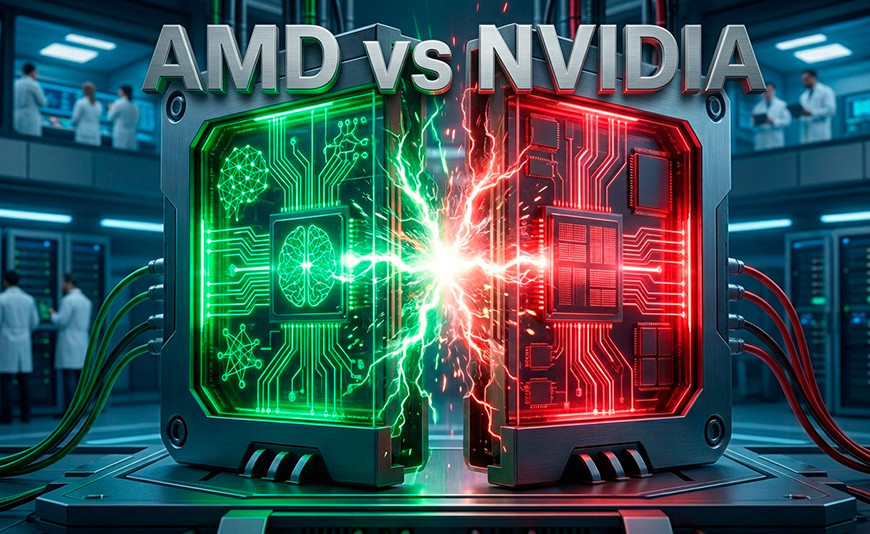
NVIDIA vs. AMD: The Battle for Digital Supremacy
Exploring the next-generation GPU ecosystem. From extreme ray tracing to watts-per-performance efficiency, discover which architecture defines the future of your enterprise.
1. The Paradigm Shift: Beyond Teraflops
In 2026, raw power is no longer the sole indicator of success. The industry has fragmented into specific needs: the Machine Learning professional seeks Tensor cores, the architect requires driver stability, and the enthusiast gamer demands flawless AI image reconstruction.
NVIDIA has doubled down on a highly specialized closed ecosystem, while AMD continues to lead the charge for open standardization and pure rasterization efficiency. This dichotomy forces companies and users to look beyond the box and understand the engineering beneath the shroud.
NVIDIA: The Supremacy of Specialized Ecosystems
NVIDIA remains the absolute benchmark for Ray Tracing and scaling technologies like DLSS 4/5. Its competitive advantage lies in its software stack:
- Dedicated AI Cores: Vital for frame generation and noise reduction in real-time renders.
- Workstation Dominance: The CUDA architecture is currently the industry standard for scientific simulations and advanced 3D design.
- Thermal Stability: Founders Edition models have improved heat management, though power draw remains the highest in the market.
AMD Radeon: The High-Efficiency Alternative
AMD has responded with a chiplet-based architecture that prioritizes massive VRAM and native rasterization. For users who prefer not to rely on reconstruction algorithms, AMD offers the most honest and powerful experience in terms of raw memory.
Their FSR (FidelityFX Super Resolution) technology is now an open standard benefiting the entire industry, allowing even budget-conscious teams to compete in high-resolution professional environments.
The Heart of the System: Uncompromising Power
Whether you choose NVIDIA or AMD, the component that will determine your system's lifespan is the Power Supply Unit (PSU). Power fluctuations in 2026 GPUs are more aggressive than ever.
The Hiditec BZ PRO series, with its DC-DC topology and high-end filtering, ensures these components receive a stable electrical flow, eliminating the risk of reboots due to transient power spikes. A high-end GPU cannot rely on a generic PSU; the BZ PRO is the security investment every professional must make.
Spatial Architecture: Hiditec BLOK
Current graphics cards often exceed 340mm in length. The most common mistake is mounting them in cases with restrictive airflow. The Hiditec BLOK chassis solves this via a robust steel design and internal volume optimized for large Workstations.
With no unnecessary lighting, magnetic filters, and clearance for GPUs up to 350mm, the BLOK allows your NVIDIA or AMD investment to breathe and perform at 100% capacity without thermal throttling.
| Category | NVIDIA RTX (50-Series) | AMD Radeon (8000-Series) |
|---|---|---|
| Ideal Use | AI, 3D Render, Ray Tracing | 4K Gaming, Video Editing, Value |
| Power Draw | High (Requires BZ PRO 850W+) | Moderate (Requires BZ PRO 750W+) |
| Software | CUDA / DLSS Ecosystem | Open Software / FSR / ROCm |


Leave a Reply Cancel Reply