
 Español
  Português PT
Japanese Capacitors in PSUs: Do they actually boost performance?
- 23 Mar, 2026
- Home
- 0 Comments
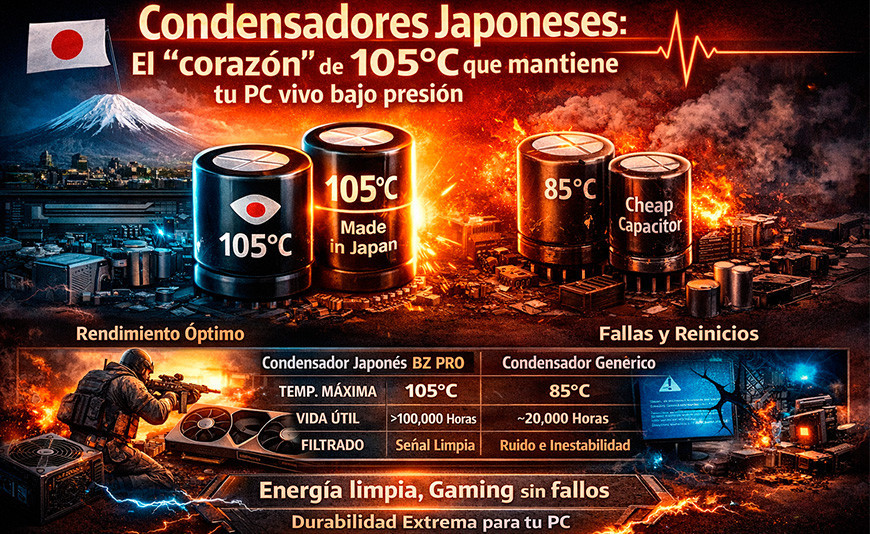
Japanese Capacitors: The 105°C "Heart" keeping your PC alive under pressure
Beyond Wattage: The untold truth about clean power
In our previous posts, we’ve talked about OVP or SCP protections acting as shields. Today, however, we’re looking at the engine that keeps power flowing without a hitch. If you’ve ever experienced a sudden crash during a gaming session or heard an annoying electrical whine coming from your tower, the culprit is usually the same: shoddy, low-quality capacitors.
In our new BZ PRO series and the BZ850 V2, we don’t take gambles. We’ve opted for Japanese-made capacitors certified to operate at 105°C. Why is this a game-changer for your performance? Let’s break it down.
1. Japanese Standard vs. Generic: Why does origin matter?
A capacitor is essentially a tiny energy reservoir that filters and stabilises voltage.
Extreme Durability: Japanese capacitors (like those in the BZ range) use higher-purity electrolytes. This allows them to last up to 4 times longer than generic Chinese or Taiwanese capacitors under the same heat conditions.
Thermal Resilience: While standard components start to struggle at 85°C, ours are certified for 105°C. In a high-performance rig where internal temps can soar, this thermal headroom is the difference between a PSU that lasts two years and one that lasts ten.
2. Real-World Performance with High-Draw GPUs (RTX 4080 / 5080)
As we’ve seen with the BZ PRO series for high-end builds, modern graphics cards have "transient spikes"—milliseconds where the GPU demands a massive surge of power.
Without Japanese Capacitors: The voltage oscillates (ripple). This instability hits your motherboard and GPU, causing system crashes or micro-damage to your expensive card's VRMs over time.
With the BZ PRO Series: The capacitors act as a perfect buffer. They filter out that electrical noise, delivering a flat, stable +12V line. Your hardware receives "premium fuel," extending the life of your components.
3. Gaming Experience: Capacitors vs. The Rest
What do you actually notice as a user when using a high-quality PSU in demanding titles?
Case A: Microsoft Flight Simulator or Cyberpunk 2077 (Constant Loads)
These games keep your CPU and GPU at 90-100% usage for hours.
The Benefit: By using 105°C components, efficiency doesn't drop as the heat rises. The capacitors don't "dry out" or lose filtering capacity, preventing that annoying stuttering that occurs when voltage starts to fluctuate under thermal stress.
Case B: Counter-Strike 2 or Valorant (High FPS & Latency)
Here, signal cleanliness is king. Electrical noise can cause electromagnetic interference that affects your onboard audio or frame-time consistency.
Real Performance: Using Japanese capacitors reduces electrical noise to a minimum, ensuring every component hits its maximum clock speed without calculation errors.
4. Comparison Table: The Technical Reality
| Parameter | Japanese Capacitor (BZ PRO) | Generic Capacitor |
| Max Temperature | 105°C (Industrial Grade) | 85°C (Standard) |
| Estimated Lifespan | >100,000 hours | ~20,000 - 30,000 hours |
| Ripple Filtering | Excellent (Clean Signal) | Poor (Instability risk) |
| Gaming Stability | Total, no restarts | Risk of BSOD (Blue Screen) |







Leave a Reply Cancel Reply