
 Español
  Português PT
RAM Price Crisis 2026: How AI Caused RAMageddon and What PC Builders Should Do Now | Hiditec Global
- 16 Jul, 2026
- Home , News
- 0 Comments
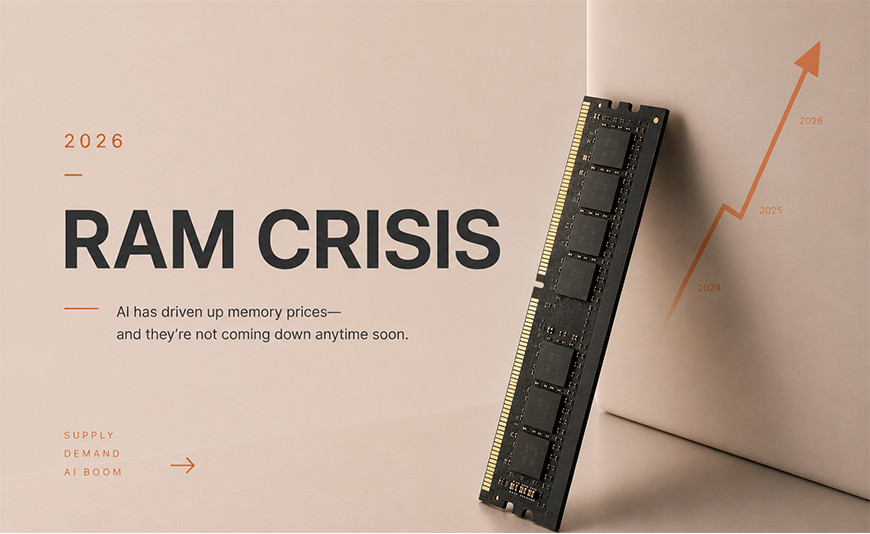
RAM prices have jumped 400%:
AI is eating your memory and no one is telling you
DRAM manufacturers have decided that an AI data center is worth more than your next upgrade. Here is the honest rundown of what's happening, why it will last until at least 2027, and what you should do right now if you're planning to build or upgrade a PC.
The raw numbers: a 32 GB DDR5-6000 kit, which cost less than 90 € in early 2025, is now selling for over 500 €. A 32 GB DDR4 kit that cost 70 € in October 2025 now exceeds 170 €. Gartner forecasts combined DRAM and SSD price increases of 130% by the end of 2026. Micron has discontinued its consumer brand Crucial in order to dedicate its full capacity to AI data centers. And the world's only three DRAM manufacturers, Samsung, SK Hynix and Micron, are doing the same. This is not a normal pricing cycle. It's something structurally different.
There was a time, not that long ago, when RAM was the most boring component in the market. Prices kept falling, supply was abundant, and no one talked about it except to note that the recommended minimum had gone from 8 GB to 16 GB. That's over.
At some point in late 2025, the three giants that make nearly all of the world's DRAM, Samsung, SK Hynix and Micron, reached the same conclusion: AI data centers pay far more for every wafer of silicon than the consumer market does. And they started reallocating production capacity accordingly.
The result is the most severe memory crisis in decades. It has been informally dubbed RAMageddon, and its effects are already reaching the stores where you buy your hardware.
1. The root cause: why AI is eating your RAM
To understand what's happening, you need to know about a component you've probably never heard of: HBM, or High Bandwidth Memory. This is the specialized memory installed right next to AI GPUs, like the NVIDIA H100 and H200 chips inside the servers of OpenAI, Google, Meta and Amazon. And right now, demand for HBM is practically unlimited.
The single-wafer problem
It's a zero-sum game
DRAM manufacturers have a fixed amount of clean-room space and production capacity. Every wafer that goes toward HBM for an AI GPU is a wafer that doesn't go toward the DDR5 for your next upgrade. Samsung, SK Hynix and Micron control over 95% of the world's DRAM production. When all three make the same choice, there's no alternative in the market.
HBM uses four times more wafer
TrendForce estimates that producing 1 GB of HBM consumes the equivalent wafer space of 4 GB of standard DRAM. And AI data centers will absorb close to 20% of the world's total DRAM production capacity in 2026. The math is brutal for the consumer market.
The margins aren't even comparable
Hyperscalers pay up to ten times more for HBM than a consumer would pay for the same wafer capacity in DDR5. No public company can ignore that margin gap. The market is doing exactly what it's supposed to do: allocating resources to whoever values them most. The fact that it's not you doesn't factor into the equation.
2. The numbers: how far prices have climbed
The data below comes from sources such as Tom's Hardware's RAM price index, TrendForce reports, and Gartner and IDC analyses published between January and June 2026. These aren't projections: they're real market prices.
| Component | Price: mid-2025 | Price: June 2026 | Change |
|---|---|---|---|
| 32 GB DDR5-6000 CL30 kit | ~€85–90 | ~€500–530 | +480% |
| 32 GB DDR4-3200 CL16 kit | ~€60–75 | ~€150–180 | +140% |
| 1 TB NVMe SSD (mid-range) | ~€70–90 | ~€140–170 | +90% |
| 16 Gb DRAM chip (spot price) | ~$6.84 (Sep. 2025) | ~$27.20 (Dec. 2025) | +298% in one quarter |
3. The signs confirming this isn't temporary
Some component crises are cyclical: supply readjusts, prices fall, and everything returns to normal within six to twelve months. This one doesn't look like that. Here are the signs that confirm it:
Micron has discontinued its Crucial consumer brand
In February 2026, Micron, the only US-based DRAM manufacturer, announced the end of its Crucial brand, which for years had been the go-to choice for millions of builders. The company has stated it is leaving the consumer market to focus on its largest strategic customers: AI data centers. When the manufacturer that made the RAM kit you put in every recommendation openly says it's no longer interested in you as a customer, the market has changed in a structural way.
Samsung has told its OEMs there's no stock
Industry sources in Taiwan reported that Samsung passed on a simple message to its manufacturing customers: no conventional DRAM stock is available. This isn't a pricing issue; it's a physical absence of product in standard distribution channels. When the world's largest memory manufacturer can't supply its regular customers, prices can only move in one direction.
New RAM manufacturers won't arrive before 2028
Building a new memory semiconductor fab takes four to six years and costs tens of billions of euros. Micron has plants under construction in Idaho, but its own executives have admitted they won't have a meaningful impact on the consumer market before 2028. SK Hynix has committed an additional $15 billion to capacity expansion, but that too is aimed mainly at HBM. There's no short-term rescue coming.
A video game now recommends 64 GB of RAM
To top it off, the first commercial title has already appeared listing 64 GB of RAM among its recommended requirements. In a context where 32 GB is already expensive, this news carries a significant psychological impact on the gamer and builder community. The debate over whether 16 GB is still enough in 2026 is now officially settled.
4. Who it affects and how
Builders and upgraders
The hardest-hit segment. People who build their own PCs buy components at market price without the negotiating power of a Lenovo or a Dell. Taiwanese distributors are in some cases even requiring RAM purchases to be bundled with a motherboard, driving up the cost of any individual purchase even further.
Gamers with 16 GB
16 GB of RAM, the dominant standard in the gaming community until very recently, is starting to fall short in modern titles. Upgrading to 32 GB cost under €70 a year ago. Today that same upgrade tops €150, and the trend doesn't invite optimism.
Laptop and prebuilt buyers
Big manufacturers have more negotiating muscle, but they've still announced 15-20% increases to their retail catalog prices for the second half of 2026. Buying now, before those increases show up in the retail price, is a real advantage.
5. What you should do right now: an action guide
The situation is what it is. We can't change it. What you can control is how you navigate it. These are the decisions worth making today:
If you're going to upgrade, do it now: don't wait
The CEO of MAINGEAR, one of the leading American system integrators, put it bluntly: consumers considering a RAM, SSD or GPU upgrade shouldn't wait. Every market signal points to prices continuing to rise through 2026 and possibly into 2027. Waiting for a short-term drop isn't backed by current data.
DDR4 is now the smart choice for most people
DDR5 prices have risen far more sharply than DDR4, since DDR5 production overlaps more with HBM manufacturing lines. A 32 GB DDR4 kit at €150-180 is still a reasonable buy for a gaming or work system. In real-world gaming performance, the difference between DDR4 and DDR5 in most titles is under 5%. In price, the gap today exceeds 200%.
Don't pay the speed premium on DDR5 if you have to buy it
If your platform requires DDR5, or you already have it and need to expand, go for base speeds like DDR5-4800 or DDR5-5200. High-performance DDR5-6000 or DDR5-7200 kits carry a steep price premium that makes no sense in the current situation. The real-world performance difference in games and everyday applications doesn't justify the extra cost.
Upgrade your storage too, if you need it
NAND Flash, the technology behind SSDs, is undergoing the same manufacturing-capacity shift. SSD prices have already risen between 50 and 100%, following the same trend as DRAM. If your SSD is close to its limit, this isn't the year to put off the upgrade.
Compare prebuilts before ruling them out
For the first time in many years, building a PC from scratch doesn't always come out cheaper than buying a prebuilt system. Big manufacturers have access to RAM and storage at contract prices that individual buyers can't match on the spot market. If you're starting from zero, it's worth comparing a prebuilt before automatically assuming self-building is the cheaper option.
6. When does all this end?
The honest answer is: no one knows for sure, but the most optimistic forecasts point to 2027, and the most pessimistic ones to 2028 or later. The reason is that the factors driving this crisis are structural, not accidental.
The two possible scenarios
Optimistic scenario: 2027
The new DRAM fabs currently under construction (Micron in Idaho, SK Hynix's expansion) start contributing extra capacity. At the same time, hyperscalers' AI investment cycle moderates slightly. Conventional DRAM supply for the consumer market grows enough for prices to start correcting. This scenario is possible, but it requires several things to go right at once.
Pessimistic scenario: 2028 or later
AI infrastructure investment keeps accelerating. Each new generation of AI GPUs requires more HBM than the last. New memory competitors (like Chinese manufacturer CXMT) fail to reach the volume or quality needed to rebalance the market. Prices stay elevated for several more years. Gartner and Tom's Guide consider this the more likely scenario today.
Summary: what actually matters
The 2026 RAM crisis isn't a bump in the road. It's the predictable consequence of the most profitable industry in the world, artificial intelligence, deciding it needs all the memory it can get and can pay whatever it takes to get it. The world's only three DRAM manufacturers said yes.
For builders and gamers, the practical takeaway is clear: if you need to upgrade or build, do it now and do it smart. DDR4 for compatible platforms, no paying speed premiums on DDR5, and eyes open about what's happening with storage.
And if anyone asks you why RAM is so expensive, now you have the answer: because a data center in Virginia needs it more urgently than you do. At least for now.
Frequently asked questions about the 2026 RAM crisis
What every builder and gamer is asking right now
How much RAM do I need for gaming in 2026?
For the vast majority of current titles, 16 GB is still functional, but more and more cases are showing up where 32 GB makes a real difference in stability and load times. The first game to list 64 GB among its recommended requirements has already appeared, marking a trend that isn't going to reverse. If you have 16 GB and your platform supports DDR4, upgrading to 32 GB with a DDR4 kit is the best cost-to-impact upgrade you can make right now.
Is it better to buy DDR4 or DDR5 right now?
It depends on your platform. If your motherboard supports DDR4, stick with DDR4: the gaming performance gap between DDR4 and DDR5 rarely exceeds 5%, while the price gap today exceeds 200%. If your platform only supports DDR5, Intel 12th gen or later, AMD Ryzen 7000 and up, go for base speeds like DDR5-4800 or DDR5-5200. There's no reason to pay extra for high-speed DDR5-6000 or higher kits in the current pricing environment.
Will prices drop before the end of 2026?
The forecasts aren't encouraging. Gartner, TrendForce and IDC all agree that prices will keep rising through the rest of 2026, with a possible stabilization in 2027 if the major producers' additional manufacturing capacity starts reaching the consumer market. Waiting for prices to drop this year isn't supported by any real market signal. Micron has been the most direct: its new plants in Idaho won't have an impact on the consumer market before 2028.
Does this crisis also affect graphics card prices?
Indirectly, yes. GDDR, the memory used by GPUs, is also under pressure, though to a lesser extent than consumer DRAM. Some graphics card manufacturers have already warned of increases to their list prices. The most visible effect for the gaming market is that prebuilts and gaming laptops are getting more expensive because of system memory, even when the GPU's own price hasn't changed. It's a domino effect that impacts the total cost of any build.
Can I mix my current RAM modules with new ones to expand capacity?
Technically possible in many cases, but not ideal. Mixing modules of different brands, speeds or latencies can force the system to run at the lowest common denominator of both, meaning the speed of the slower module, and in some cases can cause stability issues. If you're expanding, it's best to buy a full kit for the free slots on your board, matching the brand and specs of your existing modules whenever possible.
Why have SSD prices also gone up if the problem is with RAM?
NAND Flash, the underlying technology in SSDs, is made by the same manufacturers as DRAM, Samsung, SK Hynix and Micron, and they're in exactly the same situation: production capacity diverted toward higher-margin data center products. The result is that RAM and storage are seeing parallel price hikes. SSDs have risen between 50 and 100%, somewhat less steep than DRAM, but enough to hit the budget of any new build.
Does it make sense to buy used RAM in this context?
It's an option worth exploring, especially for standard-speed DDR4 kits from owners selling to migrate to newer platforms. The secondhand market hasn't absorbed the same level of price increase as the new-product market yet, which creates real opportunities. The risks are possible speed or XMP profile incompatibility and the lack of manufacturer warranty. If you go this route, always buy from sellers with a verifiable track record and confirm compatibility with your motherboard before closing the purchase.
Sources consulted:
- IDC: Global Memory Shortage Crisis, Market Analysis 2026 (February 2026)
- Shattered.io: RAM Prices Up 89%, AI Memory Crunch Hits Gaming (July 2026)
- IQon Digital: The 2026 RAM Crisis, Why Memory Prices Quadrupled (updated June 2026)
- Wccftech: RAM Shortage 2026 Explained, Why AI Is Causing a DDR5 Crisis (April 2026)
- Tom's Guide: RAM Price Crisis LIVE, All the Latest Updates (ongoing coverage 2025-2026)
- DigiBuggy: Why RAM Prices Are Skyrocketing in 2026 (March 2026)
- The Register: Expect More DRAM Price Hikes as Memory Shortage Continues (June 2026)



Leave a Reply Cancel Reply