
 Español
  Português PT
AIO Liquid Cooling vs Air in 2026: The 300W+ CPU Survival Guide
- 01 Apr, 2026
- Home , News
- 0 Comments
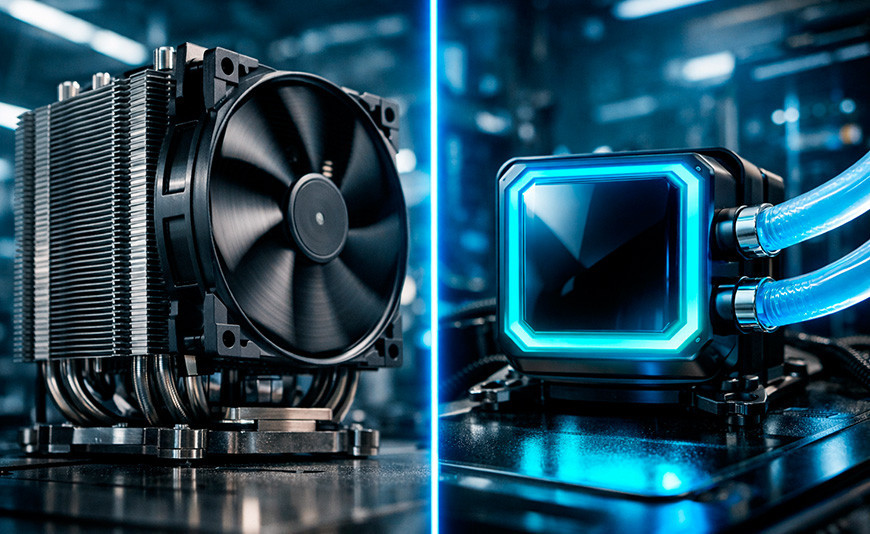
Liquid Cooling vs Air: Pushing the 300W Limit
In 2026, high-end processors have reached power consumptions that defy the laws of physics. Choosing the right dissipation system is no longer about aesthetics; it’s about the survival of your silicon.
Heat is the number one enemy of electronics. If your CPU sustains temperatures above 90°C, Thermal Throttling triggers (the processor slows down to avoid burning out), and your FPS will plummet. To prevent this, we must understand how we move heat from the IHS to the ambient air.
1. Air Cooling: The Law of Convection
The Technical Concept: It relies on heatpipes (copper tubes filled with a phase-changing fluid) that transport heat to a tower of aluminium fins.
- Unbeatable Advantages: Zero risk of leaks and near-infinite longevity (only fans can fail, and they are easily replaced).
- The 2027 Challenge: High-end dual-tower coolers are massive. They can exert excessive mechanical pressure on the socket and often block RAM slots.
? Simple terms: Think of it like a car radiator with a fan in front. Simple, reliable, and cost-effective. However, if the CPU is a "volcano", the radiator would have to be so large it wouldn't fit in your chassis.
2. AIO Liquid Cooling: Thermal Mass Management
The Technical Concept: Liquid has a much higher heat capacity than air. A pump moves fluid through copper micro-channels (less than 0.1mm wide) to capture heat rapidly.
- Static Pressure: In 2026, we use fans optimised for high-density radiators (high FPI), essential for cooling the new RTX 50-Series and 24-core CPUs.
- The SKY Factor: Chassis like the Hiditec SKY allow for 360mm radiators to be mounted at the base for pure vertical airflow, taking advantage of the fact that heat naturally rises.
? Simple terms: It’s exactly like a car’s cooling system. Water traps the heat from the engine (CPU) and carries it to the radiator for the air to cool it down. It’s more powerful and quieter but has more moving parts that could eventually fail.
2026/27 Engineering Comparison
| Feature | High-End Air | 360mm AIO Liquid |
|---|---|---|
| Dissipation Capacity | Up to 240W-260W | 350W+ |
| Maintenance | Minimal (Dusting) | Annual pump check-up |
| Electrical Safety | Total | Protected by TÜV Standards |
? Learn from the Experts
Don’t just take our word for it. Here are some of the industry’s top creators explaining real-world laboratory differences:
- Gamers Nexus: The gold standard for thermal testing and AIO orientation.
[Visit Gamers Nexus] - JayzTwoCents: Expert guides on liquid cooling aesthetics and maintenance.
[Visit JayzTwoCents]







Leave a Reply Cancel Reply