
 Español
  Português PT
Nvidia RTX Spark at Computex 2026: What it Means for Your PSU and How to Ready Your PC Build | Hiditec Global
- 10 Jun, 2026
- Home , News
- 0 Comments
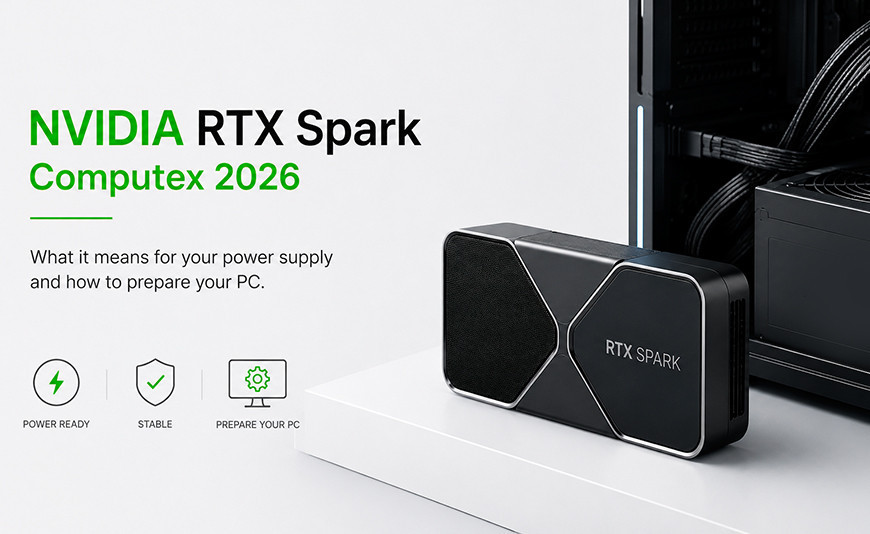
Nvidia just made your PC last year's PC:
the RTX Spark is the most powerful chip in history for Windows and here's what it means for your power supply
At Computex 2026, Jensen Huang took the stage and said Nvidia was going to reinvent the PC. It wasn't marketing: the RTX Spark Superchip (20 ARM cores, Blackwell GPU with 6,144 CUDA cores and 128 GB unified memory) is the most efficient and powerful chip ever designed for a consumer computer. And if you're thinking about building one or upgrading your current rig, there's something nobody is telling you: this generational leap is going to change the power supply standard forever.
The essentials of the Nvidia RTX Spark Superchip
Announced at Computex 2026, already available in laptops and mini-PCs. The RTX Spark Superchip integrates 20 ARM Grace CPU cores, a Blackwell GPU with 6,144 CUDA cores, 128 GB of unified LPDDR5X memory and a bandwidth of 300 GB/s. Jensen Huang presented it as the most efficient platform ever built for Windows.
TDP up to 140 W in desktop, 110 W in laptop. The DGX Spark (the mini-PC version for AI developers at $3,999) operates at 140 W. Laptops like the Microsoft Surface Laptop Ultra target 110 W. An extremely efficient power draw for a chip of this performance level.
1 petaflop of AI performance with models up to 200 billion parameters. The chip is designed to run AI locally without relying on the cloud. Nvidia positions it as the new standard for the PC of the future: not a tool the user controls, but a "companion" that autonomously runs AI agents.
The RTX 5090 remains the king for traditional desktop gaming. The RTX Spark does not replace discrete GPU desktop builds: it consumes 575 W and requires an ATX 3.1 PSU of at least 1,000 W. Two different worlds, two distinct power standards and an inflection point for PC hardware.
Some keynotes launch products. Others rewrite what it means to own a PC. Jensen Huang's Computex 2026 presentation was clearly the latter. Nvidia didn't just release a chip: it laid out its vision of what the personal computer is in the age of artificial intelligence. And for the hardware ecosystem surrounding those machines (power supplies, cooling, cases), the implications are enormous.
While the RTX Spark redefines the ultraportable and mini-PC, desktop gaming hardware is experiencing its own historic moment. The RTX 5090 with its 575 W TGP and spikes up to 900 W has established that any serious gaming build in 2026 needs a high-end ATX 3.1 power supply. Not as a recommendation — as a stability requirement.
1. What the RTX Spark is and why it changes everything you knew about PC
For years, the gaming desktop PC has followed the same logic: x86 CPU + discrete GPU + separate RAM + a PSU to power them all. The RTX Spark is not an evolution of that model. It's a completely different architecture, closer to what Apple does with its M-series chips: CPU and GPU integrated on the same die, sharing a pool of ultra-high-bandwidth unified memory.
The difference in power consumption is massive: a complete RTX Spark system consumes between 110 and 140 W total. A high-end gaming PC with an RTX 5090 and a modern processor can easily exceed 800–900 W under maximum load. These are two incompatible design philosophies that will coexist for the next several years.
| Platform | Chip / GPU | Total system draw | Recommended PSU | Standard |
|---|---|---|---|---|
| RTX Spark (laptop/mini-PC) | Grace Blackwell SoC | 110 to 140 W | Integrated adapter | N/A (SoC) |
| Gaming AM5 · RTX 5070 | Ryzen 7 7700X3D + RTX 5070 | ~450 to 550 W | 750 W ATX 3.1 | ATX 3.1 / PCIe 5.1 |
| Gaming AM4 · RTX 5080 | Ryzen 7 5800X3D + RTX 5080 | ~550 to 700 W | 850 W ATX 3.1 | ATX 3.1 / PCIe 5.1 |
| Gaming High-End · RTX 5090 | Intel/AMD top + RTX 5090 | 800 to 1,000+ W | 1,000 W minimum ATX 3.1 | ATX 3.1 / PCIe 5.1 mandatory |
2. Why the ATX 3.1 standard is no longer optional in 2026
The ATX 3.1 standard, together with the PCIe 5.1 connector (successor to the 12VHPWR/12V-2x6), was specifically designed to meet the demands of the current GPU generation. It's not a cosmetic upgrade: it introduces an official tolerance for power excursions of up to 3 times the GPU's rated power during short intervals, making it essential for GPUs drawing 300 W or more.
The 12V-2x6 connector (PCIe 5.1), also called PCIe CEM 5.1, improves on the previous version with integrated temperature-sensing pins that allow the PSU to monitor the connector in real time. The connector melting issues seen with the 12VHPWR in previous generations are resolved by design. Any serious gaming build in 2026 should start from this standard as a baseline, not as an option.
ATX 3.0 vs ATX 3.1 vs ATX 2.51: what actually matters
ATX 2.51 or older
No specification for transient power spikes. Overcurrent protection (OCP) can trip on the normal excursions of an RTX 50 series GPU, causing random shutdowns or reboots under load. Effectively incompatible with RTX 5080 and 5090.
ATX 3.0
First standard with official support for GPU power excursions. Compatible with RTX 4000 and RTX 5000. Uses the 12VHPWR connector. Valid for most current mid-to-high-end GPU builds, though already being superseded by ATX 3.1.
ATX 3.1 + PCIe 5.1 ✓
The current standard. 12V-2x6 connector with temperature pins, tolerance for spikes up to 3x the GPU's rated power. Mandatory for RTX 5090, recommended for any build with a latest-gen GPU. The foundation of the gaming hardware ecosystem for the next 3–4 years.
3. How many watts does your 2026 build actually need? The definitive guide by configuration
The question everyone asks when building or upgrading a PC: how many watts do I actually need? The answer isn't a fixed number — it depends on the GPU, CPU, drives, fans and, above all, the safety margin you want to maintain to protect components and operate in the PSU's peak efficiency range.
| Build profile | GPU | CPU | Minimum recommended PSU | Hiditec option |
|---|---|---|---|---|
| Mid gaming (1080p/1440p) | RTX 5060 Ti / RX 9070 | Ryzen 5 / i5 | 650 W ATX 3.1 | BZ PRO 650W ATX 3.1 |
| High gaming (1440p/4K) | RTX 5070 Ti / RX 9070 XT | Ryzen 7 / i7 | 750 W ATX 3.1 | BZ PRO 750W ATX 3.1 |
| Flagship gaming (4K Ultra) | RTX 5080 | Ryzen 9 / i9 | 1,000 W ATX 3.1 | GDX1050 v3 1,050W ATX 3.1 |
| Enthusiast / RTX 5090 | RTX 5090 | Ryzen 9 / i9 top | 1,000 W+ ATX 3.1 | GDX1050 v3 1,050W ATX 3.1 |
4. The perfect build for the RTX Spark era: PSU, cooling and case for 2026
The RTX Spark has redefined what a portable and compact PC can be. But for those who want the ultimate gaming experience (with a latest-gen discrete GPU, high resolution and uncompromised framerates) the ATX desktop build remains unbeatable. And in 2026, that build has three critical components that most guides ignore: a PSU meeting the current standard, sufficient cooling for the real TDP, and a case with optimised airflow.
Current processors with 3D V-Cache (especially the Ryzen 9 9800X3D on AM5 or the Ryzen 7 5800X3D on AM4) have a particular sensitivity to heat: the cache stacked on the die is the first to see performance degradation when temperatures rise. A well-cooled system isn't just quieter — it's objectively faster and longer-lasting.
The Hiditec build: components for the builder who won't compromise
Mid-range PSU · BZ PRO ATX 3.1
The Hiditec BZ PRO in 650 W, 750 W and 850 W is the ideal option for builds from RTX 5060 Ti up to RTX 5070 Ti. ATX 3.1, native PCIe 5.1, Japanese capacitors and 80 Plus certification. For 80% of builders, this range covers everything needed with reliability and competitive pricing.
High-end PSU · GDX1050 v3 ATX 3.1
For builds with RTX 5080 or RTX 5090, the right choice is the Hiditec GDX1050 v3: 1,050 W, 80 Plus Gold certification, full modular, native 12V-2x6 cable for RTX 50 series without adapters and full OVP/UVP/OPP/SCP/SIP protection. The real headroom a system with a 575 W TGP GPU and spikes up to 900 W demands.
Cooling · DC40 PRO
The Hiditec DC40 PRO (dual tower, 290 W capacity, 6 heatpipes, compatible with AM4, AM5 and LGA 1700) is the natural companion for any high-end 2026 processor. With a real TDP of 105–125 W in current gaming CPUs, the DC40 PRO works with ample headroom: temperatures below 70 °C guarantee the chip always runs at maximum boost frequency.
Case · H3 PRO Mid Tower
The Hiditec H3 PRO is an ATX and MicroATX mid-tower case designed for 2026 builds: optimised airflow for dual and triple-slot GPUs, integrated cable management and space for dual-tower coolers up to 165 mm tall. When the system's total TDP exceeds 500 W, the case airflow matters as much as the CPU cooler.
Complete recommended build for gaming in 2026
| Component | Recommendation | Why |
|---|---|---|
| CPU | Ryzen 9 9800X3D (AM5) or Ryzen 7 5800X3D (AM4) | 3D V-Cache remains the gold standard for pure gaming in 2026 |
| Motherboard | B550/X570 (AM4) or B650/X670 (AM5) with quality VRM | Stable voltage delivery under sustained boost load |
| RAM | 32 GB DDR4-3600 CL16 (AM4) or DDR5-6000 CL30 (AM5) | Latency and bandwidth sweet spot for gaming with 3D V-Cache |
| CPU Cooler | Hiditec DC40 PRO (dual tower, 290 W) | Keeps chip below 70 °C in gaming, FDB bearings, AM4/AM5/LGA compatible |
| GPU | RTX 5070 Ti / RTX 5080 / RX 9070 XT | The 9800X3D won't bottleneck these GPUs in 4K gaming |
| PSU | BZ PRO 750W (up to RTX 5070 Ti) · GDX1050 v3 1,050W (RTX 5080/5090) | Both ATX 3.1 with native PCIe 5.1 and Japanese capacitors. The GDX1050 v3 is full modular with the real headroom RTX 5080/5090 demands |
| Case | Hiditec H3 PRO Mid Tower | Optimised airflow for 500+ W TDP systems, cable management, ATX and MicroATX |
5. The real impact of the RTX Spark on the PC gaming ecosystem
The question everyone asks after Computex: does the RTX Spark make the gaming desktop obsolete? The short answer is no. The longer answer is that over the next three or four years we're going to see the coexistence of two completely different PC paradigms.
RTX Spark is for you if...
You work with AI, content creation or intensive productivity
You value energy efficiency and silence over raw gaming performance
You want a compact portable system without sacrificing too much on local AI performance
Your gaming is casual or in titles that don't push the GPU to its limits
ATX gaming build is for you if...
High-resolution gaming (1440p or 4K) with maximum fps and maximum visual quality
You want to upgrade GPU, CPU or RAM separately over the next few years
You combine gaming with streaming, video editing or 3D rendering
Price-per-gaming-performance is still your primary buying metric
Frequently asked questions: RTX Spark, PSU and gaming hardware in 2026
Everything you need to know about the new hardware ecosystem
Is the RTX Spark compatible with PC games or is it only for AI?
The RTX Spark includes a Blackwell GPU with 6,144 CUDA cores and full support for DirectX 12, DLSS 4 and ray tracing. Nvidia has confirmed support for native DirectX 12 games on Windows on ARM, with gaming performance equivalent to an RTX 4060 in compatible titles. For demanding competitive gaming or 4K, an ATX build with a discrete GPU remains superior, but the RTX Spark is not a pure productivity device — it's capable gaming in an ultraefficient package.
Do I need to replace my PSU if I have a 600 W unit from 3 years ago?
It depends on the GPU you want to install. If your build stays in the RTX 5060 or 5060 Ti range (150–200 W TGP), a 600 W ATX 2.51 PSU may be sufficient, though it's worth checking stability under load. If you're looking at an RTX 5070, 5070 Ti, 5080 or 5090, the answer is yes — you need an ATX 3.1 PSU with a native PCIe 5.1 connector. Not just because of total power draw, but because of the power spike management that latest-gen GPUs generate and that an old-standard PSU isn't designed to absorb without tripping overcurrent protection.
How much cooler does the CPU need in a build with an RTX 5080?
In a build with an RTX 5080 and a high-end processor (Ryzen 9 9800X3D, 120 W TDP), a good-quality dual-tower cooler is sufficient and preferable over a 240 mm AIO in most cases. 240 mm AIOs lose efficiency over time (fluid degradation, leak risk) and generate more noise under prolonged load. A quality cooler with 6 heatpipes and 140 mm FDB bearing fans keeps the processor below 75 °C in gaming without compromising noise levels. Liquid cooling brings a real advantage mainly in aggressive overclocking environments or cases with vertical space constraints.
What is the PCIe 5.1 connector (12V-2x6) and why does it matter?
The PCIe CEM 5.1 connector, also known as 12V-2x6, is the successor to the 12VHPWR connector Nvidia introduced with the RTX 4000 series. The main improvement is the addition of integrated temperature-sensing pins in the connector, allowing the PSU to monitor the connector's condition in real time and reduce power if it detects overheating. This resolves the connector melting issues reported in some 12VHPWR installations related to incomplete connector insertion. ATX 3.1 PSUs include this connector as standard and it's mandatory for the correct and safe operation of the RTX 5080 and 5090.
Does it make sense to wait for an RTX Spark gaming desktop or build an ATX rig now?
In the short term (2026–2027), the RTX Spark architecture is aimed at ultralight laptops and niche professional mini-PCs. Nvidia has not announced a consumer desktop version of the RTX Spark with a discrete GPU, and the Windows on ARM gaming ecosystem is still maturing. For anyone who wants the best desktop gaming experience right now, the ATX build with a discrete RTX 50 series GPU and a certified ATX 3.1 PSU remains the correct choice without any doubt. Building in 2026 with current components on an ATX 3.1 standard is laying the foundation for a platform with at least 4–5 years of relevance ahead of it.
Sources and references:
- Tom's Hardware: Computex 2026 Live Coverage · RTX Spark Superchip unveil
- Nvidia GeForce: Computex 2026 RTX Spark, DLSS 4.5 and official announcements
- IEEE Spectrum: RTX Spark brings Nvidia AI muscle to Windows PCs · TDP and efficiency
- Tom's Hardware: Surface Laptop Ultra targets 110W TDP for RTX Spark
- SlashGear: How much power the RTX 5090 can actually pull at its peak
- Tom's Hardware: What sort of power supply do you actually need for an RTX 5090?
- Seasonic: How to calculate PSU power for RTX 5090 GPUs · ATX 3.1 standard
- Amazon: Hiditec BZ PRO 750W ATX 3.1 PCIe 5.1 · official specifications
- Amazon: Hiditec GDX1050 v3 1,050W ATX 3.1 PCIe 5.1 Full Modular · official specifications
- Amazon: Hiditec DC40 PRO dual-tower cooler 290W · specifications
- Hiditec: H3 PRO Mid Tower case · specifications and compatibility




Leave a Reply Cancel Reply